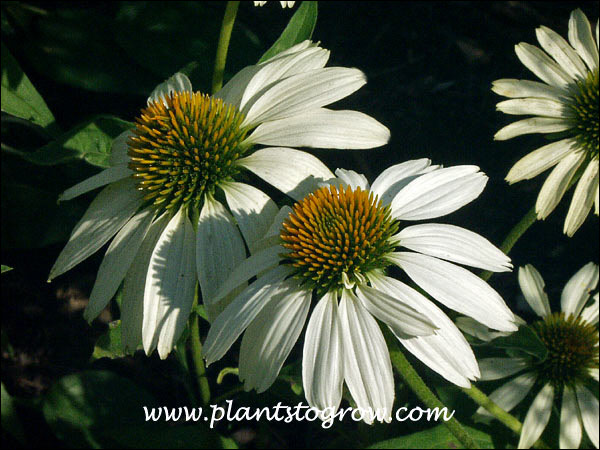
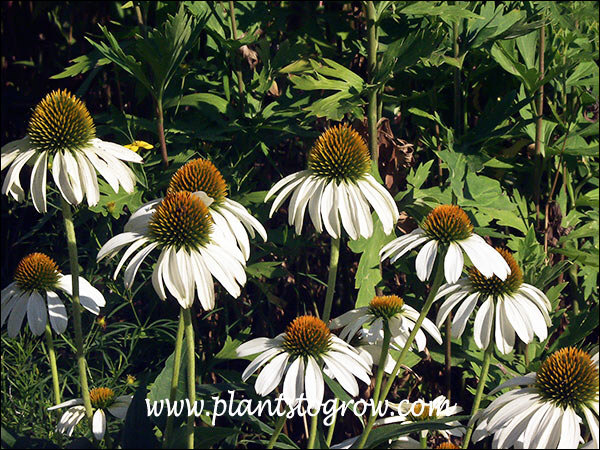
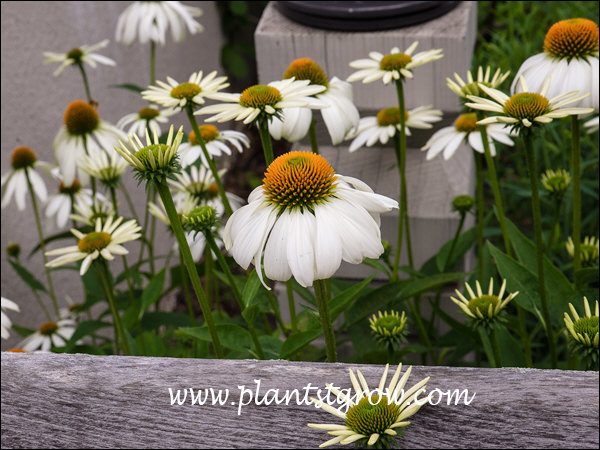
| Description | A white blooming Echinacea with large flowers and a brown/bronze cone. |
|---|---|
| Pronunciation | (eh-kin-AA-cee-ah)(pur-pur-EE-ah) |
| Plant Type | Perennials Hardy, Wild Flowers, Site author's observations |
| Hardiness Zone | 4-8 |
| Sunlight | best in full, mostly sunny, light shade |
| Moisture | average, tolerates dry once established |
| Soil & Site | average, dislikes wet winter soils |
| Flowers | 3-4 inch white surrounding a golden brown center cone, dropping ray flowres |
| Fruit | achenes in the dried center disk |
| Leaves | green, coarse, most at base of plant, some on stem but smallers |
| Stems | stout stem, has coarse white hairs |
| Roots | fibrous |
| Dimensions | 2-3 feet, space 18 inches on center |
| Maintenance | may reseed in the garden, cut back stout stem in fall or leave for winter interest |
| Propagation | seeds, division |
| Misc Facts | Echinacea from the Greek term for hedgehog, referring to the spiky appearance of the flower head. |
| Author's Notes | Echinacea have beautiful flowers, now available in a wide range of colors. The foliage is on the coarse side and many times starts to fade a way or deteriorate sooner than other plants. Using in combination with other plants will help mask these problems. I like to leave the flower heads on during the winter, since birds will dine on the seeds. |

Cart