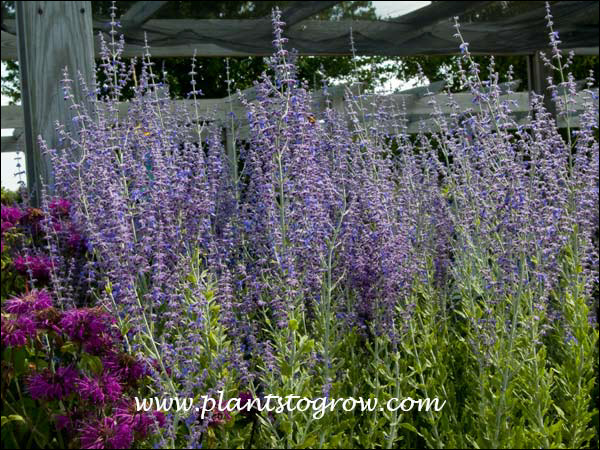
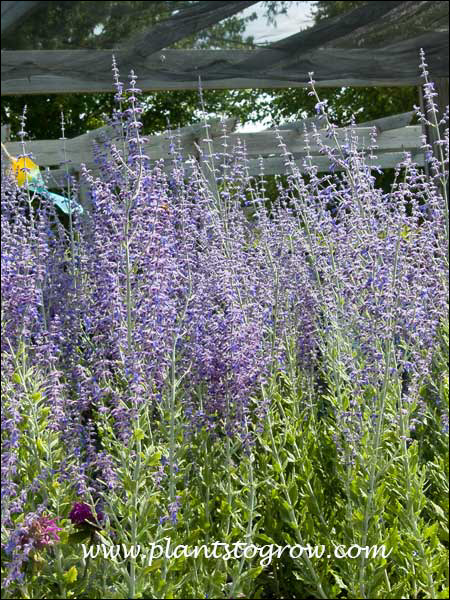
| Description | A compact cultivar of the larger Russian Sage. |
|---|---|
| Pronunciation | (per-OFF-skee-uh) |
| Plant Type | All Plants, Perennials Hardy |
| Hardiness Zone | (3)4-9 |
| Sunlight | full |
| Moisture | average, tolerates drought |
| Soil & Site | average, can't tolerate wet soils especially in the winter, this is sure death |
| Temperature | top parts of the plants are killed with light frosts |
| Flowers | tubular lavender blue flowers borne in terminal racemes or panicles |
| Leaves | fragrant when crushed (especially when I prune the plants), leaves and stems whitish gray in color |
| Stems | square stems typical of the Lamiaceae family |
| Dimensions | around 24 inches tall with a spread of 1/2 to 3/4 of height |
| Maintenance | in the fall don't cut flush with the ground, I like to leave 6 or more inches of stem, this is where the new buds will form for the next growing season, also I will periodically prune back some of the branches to help prevent the "Perovskia Flop" which is common to this group |
| Propagation | cuttings |
| Native Site | Russian Sage is not native to Russia but is found in Afghanistan & western Pakistan. |
| Cultivar Origin | This cultivar was breed by Herbert Oudshoorn an introduced by Future Plants |
| Misc Facts | The genus is named for VA Perovskia Russian general. |
| Author's Notes | When the Magnolia start dropping their petals (really tepals) I call this "Magnolia Snow". When the Perovskia start dropping their petals the area around the plant is littered with bluish petals or "Perovskia Snow". |
| Notes & Reference | #04-Herbaceous Perennial Plants (Allan Armitage), #79-Perennials For Every Purpose (Larry Hodgson) |

Cart