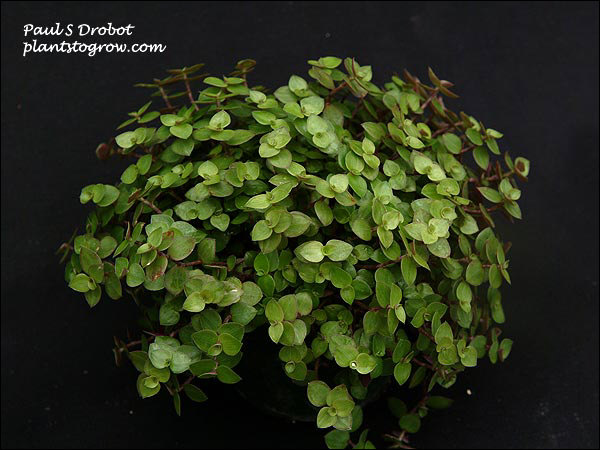


| Description | Turtle Vine (Callisia repens) is a green, fast-growing vine. Grown as a ground cover in warm climates and as a cascading house plant in colder climates. |
|---|---|
| Pronunciation | (kah-LEE-see-uh)(reh-PENZ) |
| Plant Type | Indoor Foliage, Perennial Tender, Site author's observations |
| Hardiness Zone | Cold 9-10, Sunset 1-24 |
| Sunlight | Grows best in bright to moderate. It may burn or fade in strong direct light. |
| Moisture | evenly moist to slightly dry |
| Growing Media | average house |
| Flowers | Produces small white flowers in the leaf axils, with little or no ornamental value. It is a shy bloomer when grown as a houseplant. |
| Leaves | Simple orbicular, clasping leaves, green on top and purple on the underside. Having different colors on the top and bottom of a leaf is called discolorous (discolor) |
| Stems | The stems are a vine, and the newer ones will be reddish. |
| Dimensions | A creeping vine reaching over 2 feet, filling the diameter of the pot. |
| Maintenance | With time, it will form a thick potted plant. This results in many dead leaves inside the plant. If possible a good shake will cleanup the plant. Cutting back to maintain size. |
| Propagation | Roots easily from cuttings. |
| Native Site | Native to Southeast Texas and Tropical America. They are found in shady, rocky areas, forests, and shrublands. |
| Misc Facts | Callisia is derived from the Greek calli, meaning beautiful, charming, or lovely. Syn. Hapalanthus repens, Spironema robbinsii |
| Author's Notes | This was a common plant found growing in the high schools greenhouse. Since we made dish gardens and terrariums it was good as a spiller or ground cover. |
| Notes & Reference | #270-North Carolina Extension Gardener Tool Box (https://plants.ces.ncsu.edu/plants), #274-Site Authors' observations and growing experiences |

Cart